


Día de los Muertos: A Beautiful Example of Remembering Out Loud

In many cultures, the dead are spoken of in hushed tones — or not at all. Día de los Muertos, the Day of the Dead, offers a different picture: families gathering to say their loved ones' names out loud, to cook their favorite foods, to tell their stories, and to welcome their memory home with light, color, and music.
For families who celebrate it, Día de los Muertos is a deeply meaningful tradition. For all of us who support grieving children, it offers a powerful lesson: remembering can be joyful, and children belong at the center of it.
What is Día de los Muertos?
Día de los Muertos is celebrated primarily on November 1 and 2 in Mexico, in parts of Central and South America, and in Mexican American and Latino communities across the United States. According to the Smithsonian, its roots reach back to Indigenous Mesoamerican peoples — including the Aztec, Maya, and Toltec — who set aside times to honor the dead. After Spanish colonization, these traditions became intertwined with the Catholic observances of All Saints' Day and All Souls' Day. In many families, November 1 is dedicated to children who have died, and November 2 to adults.
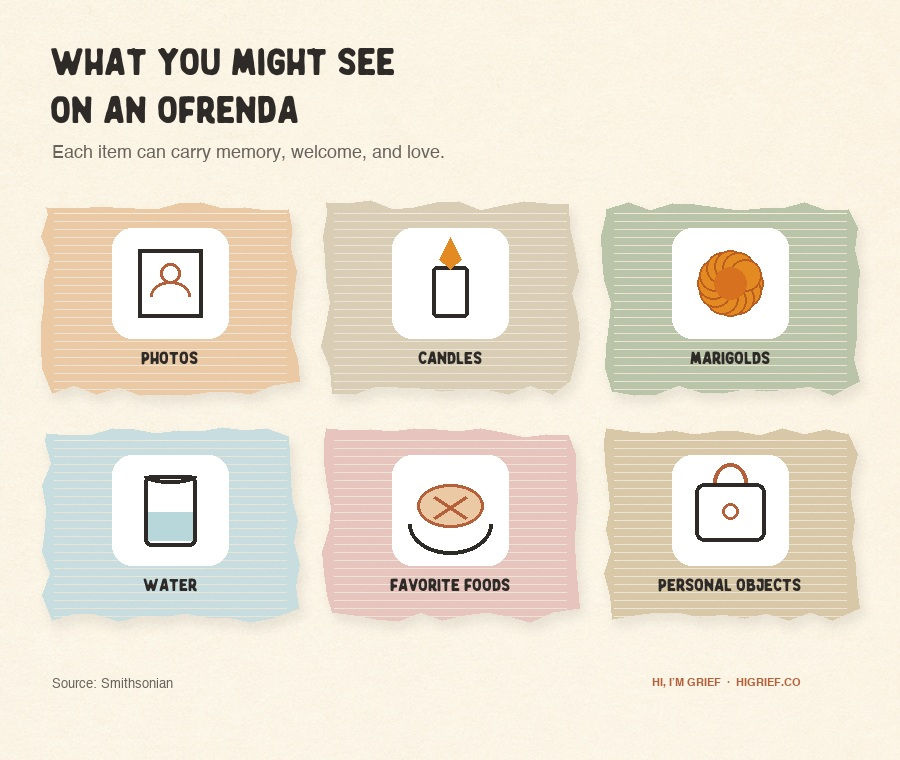
At the heart of the celebration is the ofrenda — an offering or altar built at home, in a community space, or at a gravesite. Ofrendas often hold photos of loved ones, candles, marigolds (cempasúchil), water, their favorite foods and drinks, pan de muerto, sugar skulls (calaveritas), and personal objects. The bright colors and whimsical skeletons aren't meant to be frightening; they reflect a view of death as part of the cycle of life.
Día de los Muertos is not "Mexican Halloween." The two are different holidays with different histories and meanings.
What it teaches us about grief
Say their names. On an ofrenda, a loved one is named, pictured, and remembered specifically — not as "the person who passed," but as Abuela Rosa who loved mangoes and telenovelas. Children thrive when adults are willing to say the name of the person who died.
Remembering can hold joy and sorrow together. Día de los Muertos is filled with music, food, and laughter, alongside tears. Children often feel guilty for laughing or having fun after a death. This tradition models that joy and grief can share the same table. (See Is It Okay for a Child to Feel Happy While Grieving?)
Children have a role. Kids help arrange marigolds, place photos, choose favorite candies, and hear stories from older relatives. Being included gives children a way to do something with their love — which is often exactly what grief needs.
The relationship continues. Rather than asking the living to "move on," Día de los Muertos affirms that the bond between the living and the dead continues. Grief research calls this continuing bonds — and it's one of the healthiest ways children carry loss over time.
If your family celebrates
The first Día de los Muertos after a death can feel especially tender, and especially meaningful. Invite your child to help decide what goes on the ofrenda for their person: a favorite snack, a drawing, a toy they shared. Let them tell a story or simply sit nearby. If a child who died is being honored on November 1, siblings may have complicated feelings — sadness, curiosity, even worry. Keep the door open for questions.
If your family doesn't celebrate
It's natural to feel drawn to the beauty of this tradition. The most respectful way to engage is as a learner:
Attend public celebrations hosted by Latino cultural centers, museums, or community organizations.
Read children's books about Día de los Muertos written by Latino authors and illustrators.
Talk with children about what the tradition teaches — remembering out loud, honoring loved ones with joy — rather than copying sacred elements or wearing it as a costume.
Borrow the spirit in your own family's way: a memory table with photos, a dinner featuring the person's favorite meal, a night of sharing stories.
For educators

If students in your classroom celebrate Día de los Muertos, invite them (and their families) to share only if they wish — never assign it. A classroom "memory wall" where any student can add a photo or drawing of someone they love, living or not, can be inclusive for all.
Día de los Muertos reminds us that the people we love don't disappear from our stories when they die. With a little light, a favorite food, and a name spoken out loud, they come home.
Sources
Smithsonian. Five Facts About Día de los Muertos (The Day of the Dead). https://www.si.edu/stories/5-facts-about-dia-de-los-muertos-day-dead
Smithsonian American Art Museum. Día de los Muertos Family Zone. https://americanart.si.edu/events/family-zone/dia-de-los-muertos
Smithsonian's National Museum of the American Latino (via Google Arts & Culture). The Meaning of the Altar. https://artsandculture.google.com/story/the-meaning-of-the-altar-uslatinomuseum/_QUBc67lRPvBIQ
Klass, D., Silverman, P. R., & Nickman, S. (Eds.). (1996). Continuing Bonds: New Understandings of Grief. Taylor & Francis.


Comments