


Understanding Grieving Someone You Never Met

A child asks about a grandfather who died before they were born. A little boy keeps drawing the big sister who died when he was a baby. A teenager suddenly feels a wave of sadness for a parent they were too young to remember.
Adults sometimes wonder: Can you really grieve someone you never met?
Yes. Children can — and often do.
This grief is real, even if it looks different. Grief isn't only about missing shared memories. It can be about missing what could have been: the grandparent who would have taught them to fish, the sibling who would have walked them to school, the parent whose laugh they only know from videos. Some grief experts call this "ambiguous" or "non-finite" grief — a loss that doesn't come with a single clear goodbye. As grief educator Alan Wolfelt often puts it, any child old enough to love is old enough to mourn.
It often shows up later. A child may seem unaffected for years and then begin asking questions at 6, 9, or 14. New thinking skills, a school family-tree project, a milestone, or seeing a friend with a grandparent can all spark fresh curiosity and fresh grief. This is sometimes called regrief — revisiting a loss with a new level of understanding. It isn't a setback. It's growth. (We explore this more in Why Grief Can Return Months or Years Later.)

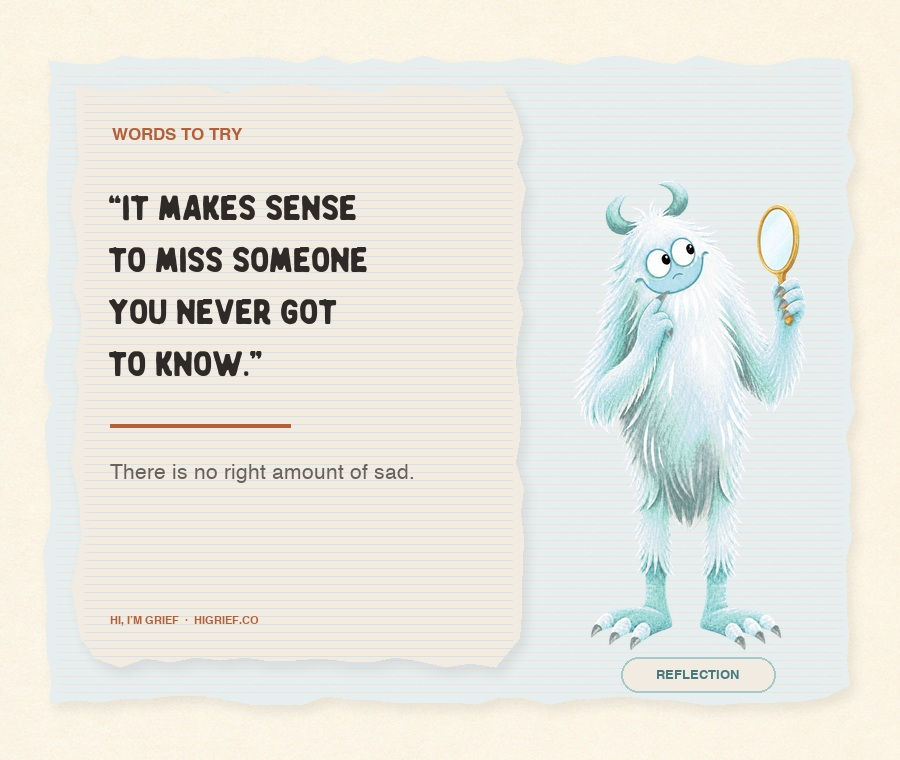
Children may feel confused about having feelings at all. Some children worry they aren't "allowed" to be sad about someone they didn't know, especially if the adults around them are grieving that person more intensely. Others feel guilty for not feeling sad. Both are common. You can say: "There's no right amount of sad. Whatever you feel about Grandpa is okay."
Let them get to know the person. One of the most healing things you can offer a child is the chance to build a relationship with the person who died. This idea — that we stay connected to people after they die, rather than "letting go" — is known in grief research as continuing bonds.
Ideas:
Share specific stories, not just facts: what made them laugh, their favorite snack, the song they always sang in the car.
Look at photos, videos, or voicemails together — let your child set the pace.
Point out connections: "You have Aunt Rosa's curly hair." "Your sister loved dinosaurs too."
Invite relatives or friends to write down a memory for your child to keep.
Create a "Getting to Know ___" book or box with photos, recipes, and small objects.
Tell the truth about how they died, in age-appropriate pieces. When children didn't witness a death, they often fill in the blanks with their imagination — which can be scarier than the truth. Offer simple, honest information and let their questions guide how much more you share over time. If the death involved suicide, overdose, violence, or another hard circumstance, you don't have to share every detail at once, but avoid telling a story you'll later need to take back. Trust built now makes future conversations easier.
Honor the feelings that don't have a name. Children who never met someone may feel wistful, curious, left out, jealous of friends, or a little bit empty. Naming these gently helps a child understand themselves. Characters like Reflection — the quiet feeling that looks back — can give young children a way to talk about wondering and missing without needing perfect words. (Meet them all on Feelings Grief Brings.)
Include them in remembering. Children who never met the person still belong in anniversaries, birthdays, and holiday traditions. Invite them to light a candle, choose a song, or add a drawing to a memory table. Belonging in the remembering helps them feel they belong in the family story.
Words to try
"You didn't get to meet her, but she would have loved you so much."
"It makes sense to miss someone you never got to know."
"Want to hear a story about him? You can ask me for one anytime."
When to reach out for more help
If a child's questions shift into ongoing distress — intense fear, guilt, trouble sleeping, or withdrawal that doesn't ease over several weeks — a grief-informed counselor can help. Our Find More Help page is a good place to start.
A child who never met the person who died can still know them, love them, and carry them forward. That connection is worth protecting.
Sources
Dougy Center. Supporting Grieving Siblings (tip sheet). https://www.dougy.org/assets/uploads/TDC_Sibling_Grief_Tip_Sheet_2018.pdf
Children's Grief Awareness Day (Highmark Caring Place). About Children's Grief Awareness Day (source of the "old enough to love" principle, attributed to Alan Wolfelt). https://www.childrensgriefawarenessday.org/cgad2/about/index.shtml
Klass, D., Silverman, P. R., & Nickman, S. (Eds.). (1996). Continuing Bonds: New Understandings of Grief. Taylor & Francis.
American Academy of Pediatrics. Supporting the Grieving Child and Family (Clinical Report, 2024). https://publications.aap.org/pediatrics/article/154/1/e2024067212/197497/Supporting-the-Grieving-Child-and-Family-Clinical
American Academy of Pediatrics, HealthyChildren.org. Grief & Loss in Childhood: How to Help Your Child Cope. https://www.healthychildren.org/English/healthy-living/emotional-wellness/Building-Resilience/Pages/Grieving-Whats-Normal-When-to-Worry.aspx


Comments