


What to Say When There Are No Good Words
There are moments in a child's grief that don't have a satisfying response — a question with no good answer, a wave of sadness that can't be fixed, a silence that words would only interrupt. Knowing that these moments exist, and that they don't require you to say something perfect, can itself be a relief.
It's okay to say you don't have the right words. "I don't know what to say right now, but I'm right here" is a complete, honest, and often deeply comforting response. Children don't need adults to have all the answers; they need adults to stay present even when the answers don't exist.

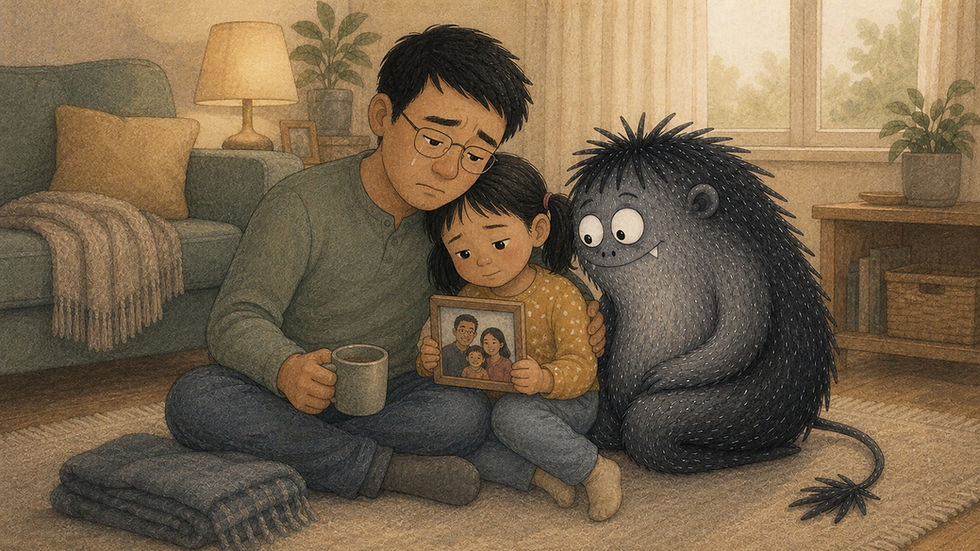
Presence often matters more than words. Sitting quietly with a crying child, without rushing to fix, explain, or distract, communicates something words can't: that their feelings are safe here, and they don't have to perform being okay for your comfort.

Resist the urge to fill every silence. It can feel unbearable to sit in a child's pain without offering something to ease it, but not every moment calls for an intervention. Sometimes the most supportive thing is simply staying close, without demanding the silence be broken.

Avoid reaching for comfort clichés under pressure. In the absence of anything better to say, phrases like "everything happens for a reason" or "she's in a better place" can slip out — but they tend to close a conversation down rather than open it, especially if they don't reflect what the child or family actually believes.

A simple, honest acknowledgment is almost always available, even when nothing else is. "This is really hard" or "I wish I could make this easier for you" doesn't solve anything, but it validates the difficulty without pretending to have a solution that doesn't exist.
Trust that your steady presence, over time, matters more than any single conversation. Grief support isn't one perfect moment of the right words — it's the accumulation of showing up, again and again, even on the days you don't know what to say.


Comments