


A Child Friendly Guide to What Happens at a Funeral
Updated: Aug 11
Funerals can feel like a very grown-up thing.
There may be words you haven’t heard before. People might be crying. You may be asked to wear certain clothes, sit quietly, go somewhere unfamiliar, or see things you weren’t expecting.
And when someone you love has died, all of those new things can feel like a lot.
So, let’s talk about what might happen at a funeral before you go.
Knowing what to expect can make something unfamiliar feel a little less scary.
First, what is a funeral?
A funeral is a gathering that happens after someone dies.
It is a time for people to come together to remember the person who died, say goodbye, comfort one another, and share how much that person mattered.
Different families have different kinds of funerals.
Some happen in churches or other places of worship. Some happen at funeral homes. Some happen outside, at cemeteries, or in places that were special to the person who died.
You might also hear words like memorial service, celebration of life, visitation, wake, or graveside service.
These gatherings can be different from one another, but they often have the same purpose:
Remembering someone who died and being together with the people who miss them.
What will I see?
That depends on the funeral.
You may see photographs of the person who died. There might be flowers, candles, music, a special book for people to sign, or objects that belonged to the person.
There may also be a casket.
A casket is a special container that holds a person's body after they die.
Sometimes the casket is closed.
Sometimes it is open, which means you may be able to see the person's body.
If you are going to a funeral where the casket will be open, a grown-up should tell you before you enter so you know what to expect.
A person's body may look different after they die. They will not move, breathe, talk, or open their eyes.
Their skin may look or feel different too.
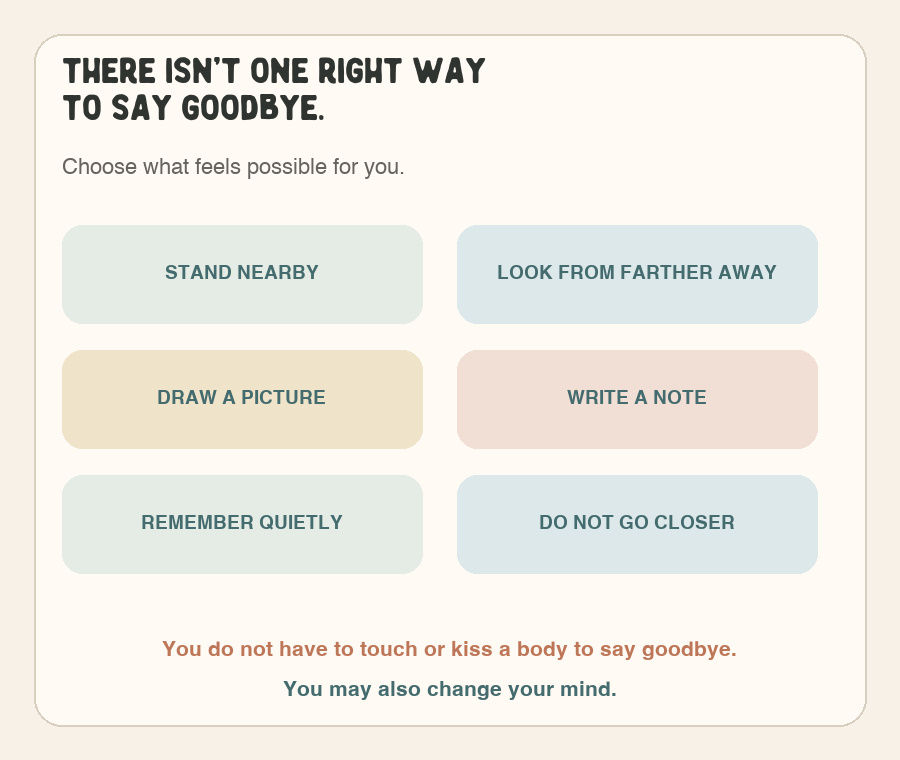
You do not have to touch or kiss someone's body to say goodbye.
You can stand nearby.
You can look from farther away.
You can draw a picture, write a note, say something quietly, remember them in your mind, or choose not to go near the casket at all.
There isn't one right way to say goodbye.
Why is everyone crying?
You may see grown-ups cry at a funeral.
Sometimes you might even see a grown-up cry who you have never seen cry before.
Crying is one way our bodies show that something hurts or that we miss someone very much.
But not everyone cries.
Someone might tell a funny story and laugh.
Someone might sit quietly.
Someone might want lots of hugs.
Someone might want to be alone.
And someone might cry one minute and laugh the next.
All of those things can happen when people are grieving.
You don't have to feel the same thing as everyone around you.
What happens during the funeral?

There isn't one way funerals happen, but you may be asked to sit with your family while people speak about the person who died.
There might be:
music
prayers or readings
stories about the person's life
photographs or videos
people sharing memories
quiet moments
laughing
crying
hugs
lots of people saying hello to your family
You may hear people use words about death that are confusing.
For example, someone might say a person was "lost," "passed away," "went to sleep," or "is no longer with us."
Adults sometimes use these phrases because talking about death can be hard.
But they usually mean:
The person's body died, and they cannot come back.
It is always okay to ask what a word or phrase means.
What happens after the funeral?
Some families go to a cemetery after the funeral.
A cemetery is a place where people who have died may be buried.
If the person is being buried, you might see their casket placed into the ground. Sometimes this happens while the family is there, and sometimes it happens later.
Other people are cremated.
Cremation is a process that happens after death where the body is turned into ashes. The ashes may be kept in a special container called an urn, buried, scattered in a meaningful place, or cared for in another way depending on the family's wishes and traditions.
Your family may also gather afterward for a meal or spend time together.
You might notice people talking and laughing more after the funeral.
That doesn't mean they have stopped being sad.
People can miss someone and still laugh.
They can be sad and hungry.
They can cry and play.
They can grieve and have a good moment.
Sometimes our feelings make room for more than one thing at a time.
What if I don't want to go?

Tell a grown-up you trust how you are feeling.
You might want to ask:
Will I have to see the body?
Can I sit near the door?
Can I leave if I need a break?
Who will stay with me?
Can I bring something that helps me feel safe?
What happens if I cry?
What if I don't cry?
These are good questions.
Whenever possible, children should know what will happen before they arrive and be given choices about how they participate.
You might decide you want to attend the funeral but not walk near the casket.
You might want to attend part of the service and take a break during another part.
You might want to bring a favorite stuffed animal, small object, drawing, or photograph with you.
Ask the grown-ups caring for you what choices are possible.
What if I start feeling overwhelmed?

Funerals can bring up big feelings.
Sometimes those feelings show up in your body before you even know what they are.
Your stomach might hurt.
Your heart might beat faster.
You might suddenly feel hot, shaky, angry, tired, restless, or like you really want to leave.
If that happens, find your trusted grown-up.
You can say:
"I need a break."
You don't have to explain everything right then.
You might step outside, get a drink of water, hold someone's hand, take a few slow breaths, sit somewhere quieter, or simply have someone stay beside you.
Taking a break does not mean you are doing the funeral wrong.
What if I don't feel sad?

That's okay too. There is no feeling you are supposed to have at a funeral.
You might feel sad.
Or confused.
Or angry.
Or nervous.
Or bored.
Or relieved.
You might even wonder when you can go home.
You might feel nothing at all.
Feelings don't measure how much you loved someone.
Grief can look different from one person to another, and it can look different from one day to the next.
You are allowed to ask questions
Death can leave us with a lot of questions.
Some questions have answers.
Some don't.
And sometimes adults don't know the answer either.
You are still allowed to ask.
You can ask what will happen.
You can ask why something is happening.
You can ask to see something.
You can ask not to see something.
You can ask for a break.
You can ask the same question more than once.
You can change your mind.
Most importantly, you don't have to understand everything about funerals, death, or grief all at once.
You are learning about something very big.
It's okay to do that a little bit at a time.
For the Grown-Ups
Children often cope better with unfamiliar experiences when adults give them clear, honest, age-appropriate information beforehand.
Before attending a funeral, try to explain what your child is likely to see, hear, and experience. Use concrete words such as died and death rather than relying only on phrases like "went to sleep" or "we lost them," which can be confusing or frightening for children.
If there will be an open casket, burial, cremation-related ritual, religious ceremony, or other unfamiliar experience, prepare the child for it before it happens.
Whenever possible, give them meaningful choices without making them responsible for adult decisions.
And consider choosing one trusted adult whose primary job during the service is to stay aware of the child's needs. That person can step outside with them, answer questions, find a snack, take a walk, or simply sit beside them without expecting them to behave a particular way.
A child who asks to leave isn't failing to grieve.
A child who plays after a funeral isn't forgetting the person who died.
A child who doesn't cry isn't grieving incorrectly.
Children move in and out of grief differently than adults do.
Our job isn't to teach them the "right" way to grieve.
It's to help them feel safe enough to discover their own.


Comments