


National Children's Grief Awareness Day — How to Mark It

On Thursday, November 19, 2026, people around the world will wear blue for grieving children.
Children's Grief Awareness Day is observed every year on the third Thursday of November — the Thursday before U.S. Thanksgiving. It was created in 2008 by the Highmark Caring Place, a center for grieving children in Pennsylvania, and has grown into an international observance. The timing is intentional: the holiday season can be one of the hardest stretches of the year for a child who is missing someone. November as a whole is also recognized by many organizations as Children's Grief Awareness Month.
Why it matters
Childhood grief is far more common than most people realize. The Childhood Bereavement Estimation Model from Judi's House/JAG Institute estimates that about 1 in 11 children in the U.S. — roughly 6.4 million kids — will experience the death of a parent or sibling by age 18. That doesn't count the many more children who grieve grandparents, friends, classmates, and pets.
Yet grieving children often feel invisible. Adults may not know what to say, so they say nothing. Classmates may not understand. And children may hide their grief to protect the grown-ups around them. Children's Grief Awareness Day exists to change that — to help grieving kids feel seen, supported, and less alone.

How families can mark the day
Wear blue — and if your child asks why, tell them. "Today we're wearing blue for kids who are missing someone who died, like you miss Grandpa."
Let your child choose how (or whether) to participate. Some grieving children love being part of something bigger. Others don't want the attention. Both are okay.
Share a memory at dinner. Invite everyone to tell one story about the person who died.
Create something together — a drawing, a candle, a paper butterfly, or a page in a memory book.
Check in gently. The day may bring up feelings. "How are you doing with Mom on your mind this week?"
How schools can mark the day
Invite staff and students to wear blue without singling out any grieving student.
Read a picture book about grief in class. (Our 5 Books for a Classroom Grief Corner is a good start.)
Share a short staff resource — like What Every School Counselor Wishes Teachers Knew About Grief — in the morning email.
Set up or refresh a grief corner with books, feelings cards, and quiet activities.
Remind families where to find help, such as the counseling office and community grief centers.
How communities can mark the day
Support your local children's grief center with a donation, volunteer hours, or a social post.
Light up in blue — some businesses and homes light their windows or buildings blue throughout November.
Post on social media using #ChildrensGriefAwarenessDay to help spread awareness.
Learn one new thing about how to support a grieving child — like what not to say.
For grieving children themselves
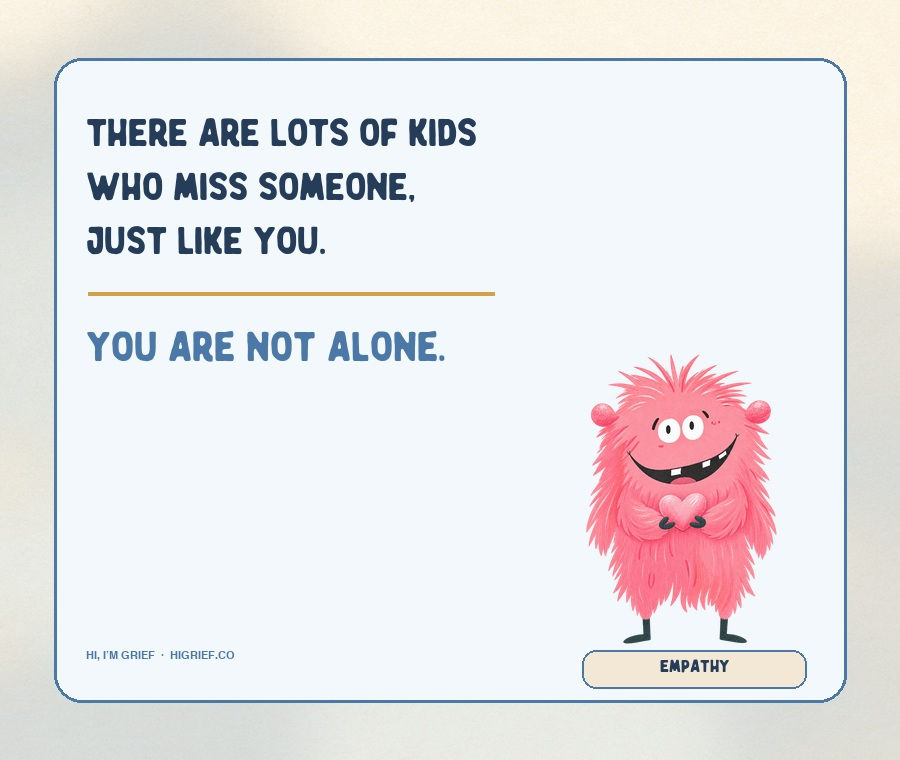
If you're a grown-up reading this with a grieving child, you might share this simple message: There are lots of kids who miss someone, just like you. Today, people everywhere are thinking about you. You are not alone.
One day in November won't erase a child's grief. But it can remind them — and all of us — that grieving kids deserve to be noticed every day of the year.
Looking for a place to start? Visit Feelings Grief Brings, explore our free printables on the Download page, or find support options on Find More Help.
Sources
Highmark Caring Place. About Children's Grief Awareness Day. https://www.highmarkcaringplace.com/cp2/aboutus/cgad.shtml
Children's Grief Awareness Day. About and FAQs. https://www.childrensgriefawarenessday.org/cgad2/about/index.shtml
Judi's House / JAG Institute. Childhood Bereavement Estimation Model (CBEM), 2026 estimates. https://judishouse.org/
National Alliance for Children's Grief. Data & Statistics. https://nacg.org/data-statistics/



Comments