


What Every School Counselor Wishes Teachers Knew About Grief

Nearly every classroom has a grieving student in it. According to the Childhood Bereavement Estimation Model from Judi's House/JAG Institute, about 1 in 11 U.S. children will experience the death of a parent or sibling by age 18 — and many more will lose a grandparent, friend, or other important person. Most teachers want to help. Most were never trained to.
School counselors can't be in every classroom, every period. Here's what many of them wish every teacher knew.
1. You don't need to be a grief expert to help. Grieving students generally don't need a therapist in every adult they meet. They need adults who notice, stay steady, and don't look away. A brief, private acknowledgment — "I heard about your grandma. I'm really sorry. I'm here if you need anything" — matters more than finding perfect words.
2. Saying nothing can feel like not caring. Many teachers stay silent out of fear of upsetting a student. But students often read silence as "no one noticed" or "we're not supposed to talk about this." Acknowledge the loss once, privately, and let the student know the door stays open.
3. Grief affects learning — on a delay. Concentration, memory, and motivation often dip after a death, sometimes weeks or months later rather than right away. A student who seemed "fine" in September may struggle in November. This isn't laziness. Grief takes up real cognitive space.
4. Flexibility isn't lowering the bar. Extended deadlines, shortened assignments, a quiet place to test, or permission to step out briefly can keep a grieving student connected to school instead of falling behind and giving up. Work with the counselor and family to decide what's right, and revisit it — needs change.
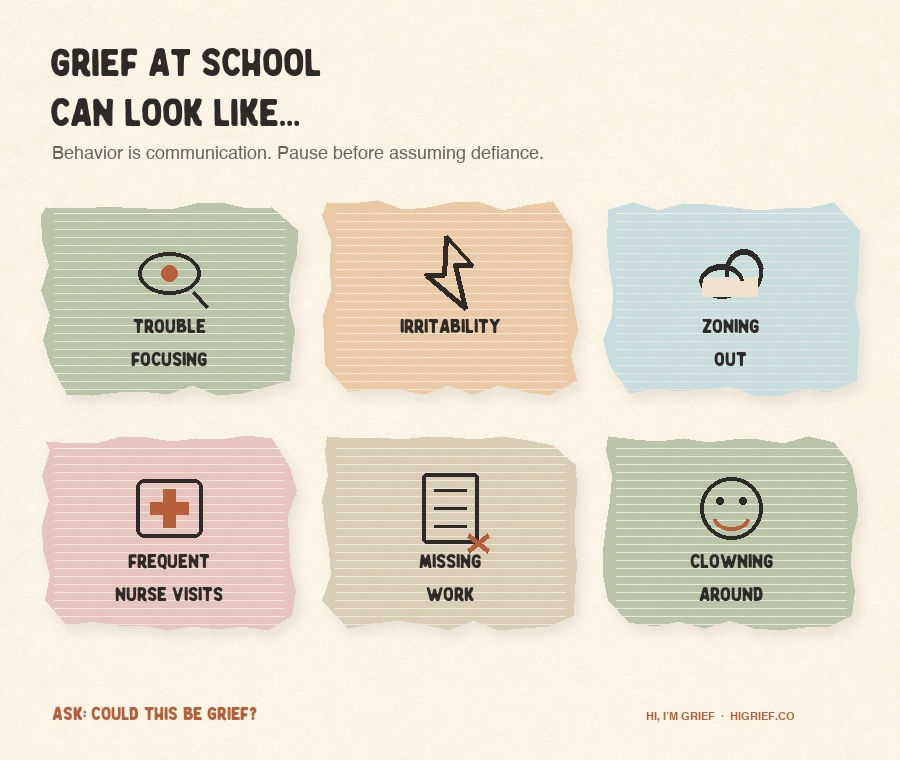
5. Grief doesn't always look like sadness. In the classroom, grief can look like irritability, zoning out, clowning around, perfectionism, frequent nurse visits, or a student who suddenly stops turning things in. Before assuming a behavior is defiance, ask: Could this be grief?
6. Some lesson content can land hard. Family tree projects, Mother's Day or Father's Day crafts, novels with a parent's death, health units on disease, or "write about your summer" prompts can blindside a grieving student. You don't have to cancel them. A quiet heads-up and an alternative option — "You can include anyone who's important to you" — goes a long way.
7. Avoid comparisons and silver linings. Well-meaning phrases like "I know how you feel," "At least she's not in pain," or "You need to be strong for your family" can make students feel misunderstood or pressured. Simpler is better: "This is really hard. I'm glad you're here."
8. Don't make them the class's teachable moment. Unless the student and family want it, avoid public acknowledgments that put a grieving child on display. Peers can be prepared to be kind without being given private details. (See How Classmates Can Support a Grieving Student.)
9. Some students need more than grief support. When a death is sudden, violent, or witnessed, some children develop childhood traumatic grief — where frightening memories of how the person died get in the way of grieving them. Watch for intense preoccupation with how the death happened, strong avoidance of reminders, jumpiness, or re-enacting the death in play or art. Loop in your counselor right away if you notice these.
10. Grief doesn't end at the funeral — or after the first year. Anniversaries, holidays, birthdays, and milestones like graduation can bring grief back to the surface years later. A note on the calendar and a quiet check-in can mean the world. (More in Grief Anniversaries at School.)
11. You're allowed to be affected, too. Supporting grieving students can stir up your own losses. That's human. Take care of yourself and lean on your counselor, colleagues, or employee assistance program.
Words teachers can use
"I'm so sorry about your dad. I'm here if you want to talk — or if you don't."
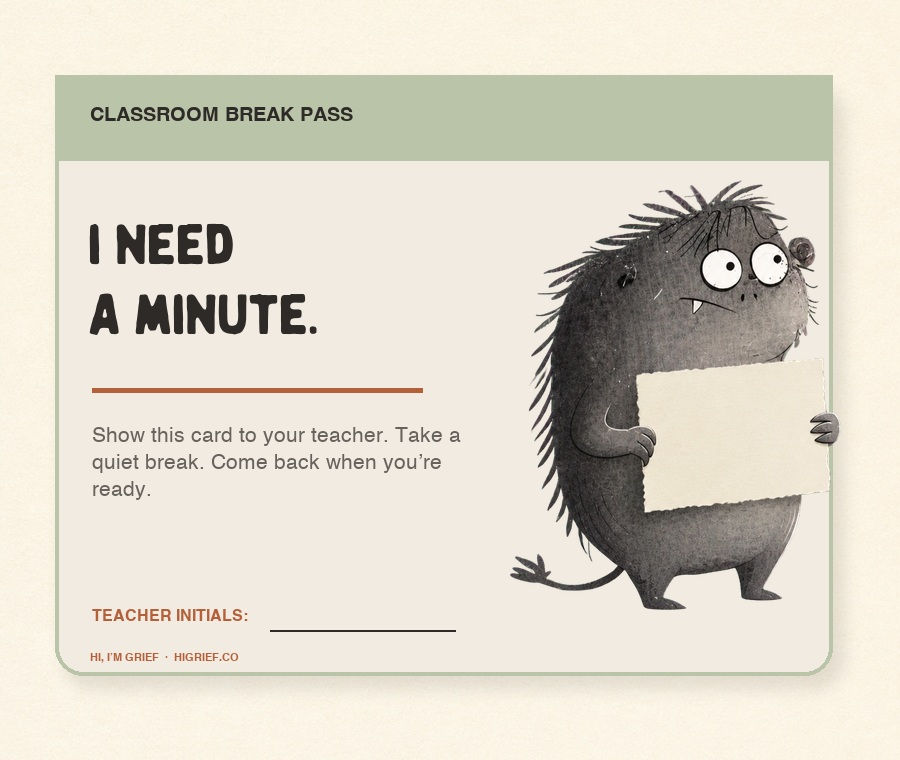
"If you need a break during class, you can use this card — no questions asked."
"Let's figure out a plan for the assignments together. There's no rush."
Keep learning
The Coalition to Support Grieving Students offers free, short training videos designed specifically for school staff — a great resource for a PD day. You'll also find classroom-ready tools on our Educator or Librarian page.
Grieving students don't need teachers to fix what happened. They need teachers who stay.
Sources
Judi's House / JAG Institute. Childhood Bereavement Estimation Model (CBEM) — 2026 national estimate: about 1 in 11 children. https://judishouse.org/
Coalition to Support Grieving Students. Free training modules for school personnel. https://grievingstudents.org/
Coalition to Support Grieving Students. Providing Support Over Time. https://grievingstudents.org/module-section/providing-support-over-time/
National Child Traumatic Stress Network. Brief Information on Childhood Traumatic Grief for School Personnel. https://www.nctsn.org/sites/default/files/resources/brief_information_on_childhood_traumatic_grief_school_personnel.pdf
National Center for School Crisis and Bereavement. Guidelines for Responding to the Death of a Student or School Staff. https://www.schoolcrisiscenter.org/resources/guide-responding-death/


Comments