


Helping Students Through Grief Anniversaries

A student's grief doesn't follow the school calendar. The anniversary of a parent's death might land on the first day of state testing. A sibling's birthday might fall during winter break. A classmate's death might be remembered by an entire grade every spring. And each August, a grieving student meets a brand-new teacher who may not know their story at all.
Classroom teachers can offer quiet check-ins on hard days (our post Grief Anniversaries at School covers that). But the student support team is in the best position to make sure those check-ins happen — this year, next year, and the year after. Here's how to build a simple, year-round system.
1. Know the dates — with the family's permission
When a student experiences a death, ask the family (and, when age-appropriate, the student) whether they'd like the school to be aware of significant dates: the death anniversary, the person's birthday, and any holidays or milestones that may be hard. Some families will welcome this; others will prefer privacy. Respect both.
Keep dates in a confidential, secure place accessible to the student support team — not in a public staff calendar.
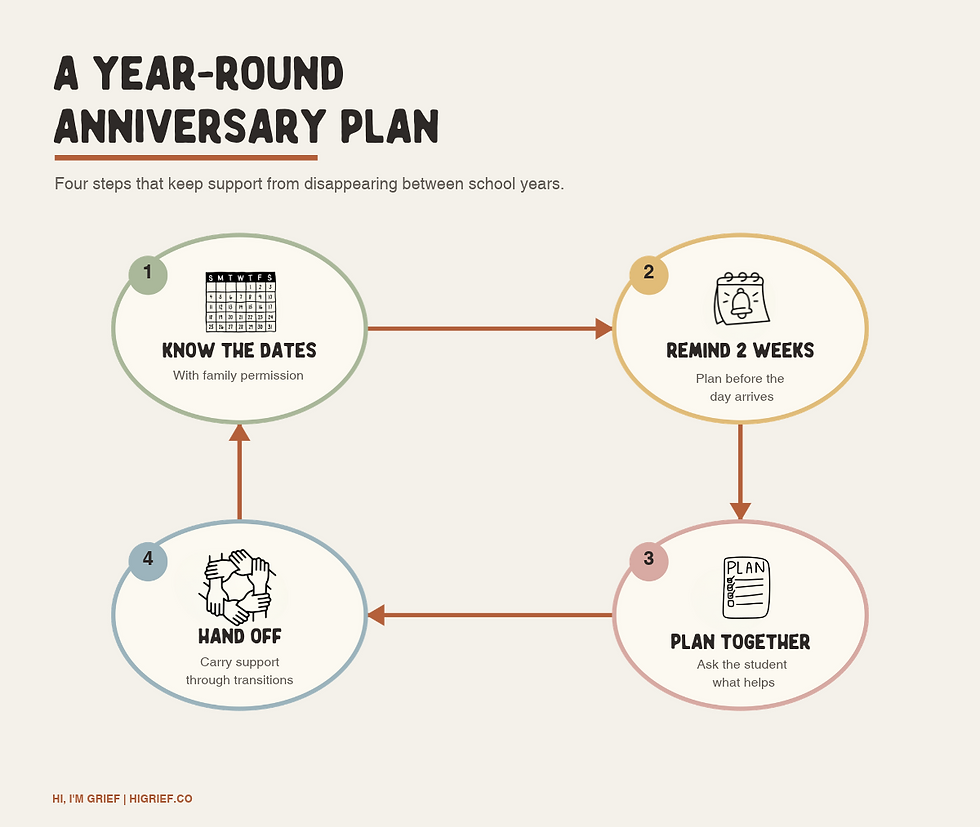
2. Add reminders 1–2 weeks ahead
Grief often builds in the days before an anniversary. Set a reminder about two weeks out so you can:
Touch base with the student privately.
Give the student's teachers a brief, need-to-know heads-up.
Check the school calendar for testing, field trips, or assemblies that might collide with the date.
3. Plan with the student, not for them
Ask what might help: "The anniversary of your mom's death is coming up next week. Some students like to have a plan for that day. What might feel helpful to you?" Options might include a lighter workload, permission to visit the counseling office, a pass to step out, or simply knowing someone is aware. Some students want the day to feel completely ordinary — that's a valid plan, too.
4. Hand off the story at transitions
The biggest gap in anniversary support often happens between school years. A new teacher, grade, or building means a student's grief can become invisible. With family permission, include a brief note in transition meetings or records so next year's team knows what to watch for.
5. Watch the school-wide calendar
Some dates are hard for many grieving students at once: Mother's Day and Father's Day, Grandparents Day, the winter holidays, graduation, and the last day of school. Share a gentle reminder with staff before these dates, suggesting inclusive alternatives for parent-themed activities.
6. Remember that anniversaries don't stop after year one
The Coalition to Support Grieving Students notes that many adults expect children to adjust within about a year, but the impact of a significant death can last a lifetime. Milestone anniversaries (5 years, 10 years), developmental leaps, and life events like graduation can bring grief back into focus. Keep dates on file for as long as the student is in your building.
7. Plan thoughtfully for anniversaries of a school community death
When a student or staff member has died, the anniversary can affect many people at once. The National Center for School Crisis and Bereavement recommends planning commemorations thoughtfully and consistently — honoring the person in ways that are meaningful, equitable across deaths, and sensitive to students who may be struggling. After a death by suicide, follow safe-messaging guidelines and avoid anything that could glamorize or sensationalize the death.
8. Watch for students who need more

Most anniversary reactions are a normal part of grief. Connect a student and family with additional support if you see intense or lasting distress, preoccupation with how the person died, strong avoidance of reminders, or signs of self-harm. These can signal childhood traumatic grief or other needs beyond everyday grief support.
A simple template to start
For each student: Name · Person who died · Relationship · Significant dates · Family permission (Y/N) · Student's preferred supports · Last check-in.
A few minutes of planning each month can mean a grieving student never faces their hardest days alone — even years later.
Sources
Coalition to Support Grieving Students. Providing Support Over Time. https://grievingstudents.org/module-section/providing-support-over-time/
National Center for School Crisis and Bereavement. Guidelines for Responding to the Death of a Student or School Staff. https://www.schoolcrisiscenter.org/resources/guide-responding-death/
Coalition to Support Grieving Students / NCSCB. Guidelines for Schools Responding to a Death by Suicide. https://grievingstudents.org/wp-content/uploads/2016/05/Guidelines-for-Schools-Responding-to-a-Death-August-7-2022.pdf
American Academy of Pediatrics. Supporting the Grieving Child and Family (Clinical Report, 2024 — includes grief triggers and anniversary reactions). https://publications.aap.org/pediatrics/article/154/1/e2024067212/197497/Supporting-the-Grieving-Child-and-Family-Clinical
National Child Traumatic Stress Network. Brief Information on Childhood Traumatic Grief for School Personnel. https://www.nctsn.org/sites/default/files/resources/brief_information_on_childhood_traumatic_grief_school_personnel.pdf


Comments